Stop floating waste before it travels downstream. Our Floating Boom Barrier is designed to intercept floating debris, oil and large waste, contain it within a designated area and make collection easier.
Key Features
100% Recyclable
UV Stable
Weatherproof
Non-Fading Colours
IALA Colours Available
MARLIN SERIES
How it works
Contain. The barrier is positioned across or along the waterway to intercept floating debris.
Redirect. It guides floating waste towards the desired collection area.
Collect. A turbidity curtain is secured along the bottom, helping retain and collect captured debris.
Applications
Zones: sea, rivers, canals, lakes, drains, stormwater channels, industrial water bodies, and barricading access to deep waters.
Ideal for controlling: plastic waste, bottles, leaves, floating litter and organic debris, general floating waste, oil containment, sand filtering.
Designed for easy deployment
Anchoring: anchoring points can be provided to suit site conditions and water flow.
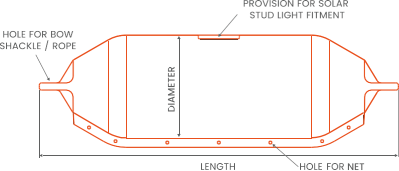
Turbidity curtain / net: bolted to the lower section with 10 mm bolts to capture and contain debris beneath the barrier.
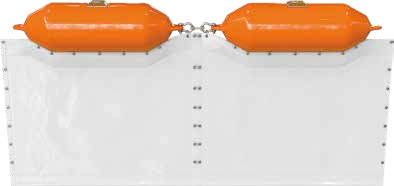
Bow shackle / rope connection: each section connects to the next with bow shackles, so multiple sections can be joined.
Technical specifications
Barrier
Size 1
Size 2
Length
1160 mm
1500 mm
Diameter
280 mm
430 mm
Hole for net dia.
10 mm
12 mm
Bow shackle size
12–18 mm
12–18 mm
Rope size
14–20 mm
14–20 mm
Turbidity curtains
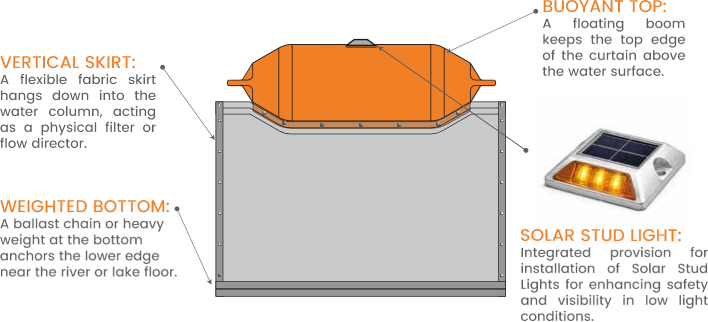
Turbidity curtains (also called silt curtains, silt screens or silt barriers) are floating barriers used in marine construction, dredging and remediation projects to control silt and sediment in water. They come in different types, and the right one depends on what you want to contain: floating debris, oil or silt. They also come in two submersion depths. Parts:
Buoyant top: keeps the top edge above the surface.
Vertical skirt: flexible fabric that acts as a filter or flow director.
Weighted bottom: ballast chain or weight anchoring the lower edge.
Solar stud light: provision to fit one for visibility in low light.
Three types to suit your area
Trash Trap Net: debris collection in inland waterways with low flow. Used for river water cleaning, canals and inland waterways.
Oil Curtain: handles moderate currents with a polyethylene skirt and extra reinforcement. Used for mid-sea oil tanker breakdowns and oil containment areas.
Silt Curtain: for challenging environments like fast-flowing rivers, with robust construction and anchoring. Used for dredging, dam maintenance, stone filtering, island construction, aquaculture and wastewater, and protecting river banks and the sea bed from erosion.
FAQs
What is a floating boom barrier used for?
It intercepts floating debris, oil and large waste, holds it in one area and makes collection easier.
What sizes are available?
Size 1 is 1160 mm long x 280 mm diameter, and Size 2 is 1500 mm x 430 mm.
Which type should I choose?
Trash Trap Net suits low-flow inland waterways, Oil Curtain suits moderate currents and oil spills, and Silt Curtain suits fast-flowing rivers and dredging or construction work.
Can solar stud lights be fitted?
Yes, the barrier has a provision for solar stud light fitment.
How are sections joined?
With bow shackles and ropes (shackle 12–18 mm, rope 14–20 mm).
Is it recyclable and UV resistant?
Yes, it is 100% recyclable, UV stable, weatherproof, with non-fading colours and IALA colours available.